
Most people who ask about Invisalign have already spent time thinking about their teeth. Maybe it’s been years. Maybe it was a throwaway comment at a family dinner that stuck with you, or a photo where your smile wasn’t quite what you hoped. Whatever brought you here, the question is always the same: does this actually work, and what does it involve?
This guide answers both.
What is Invisalign?
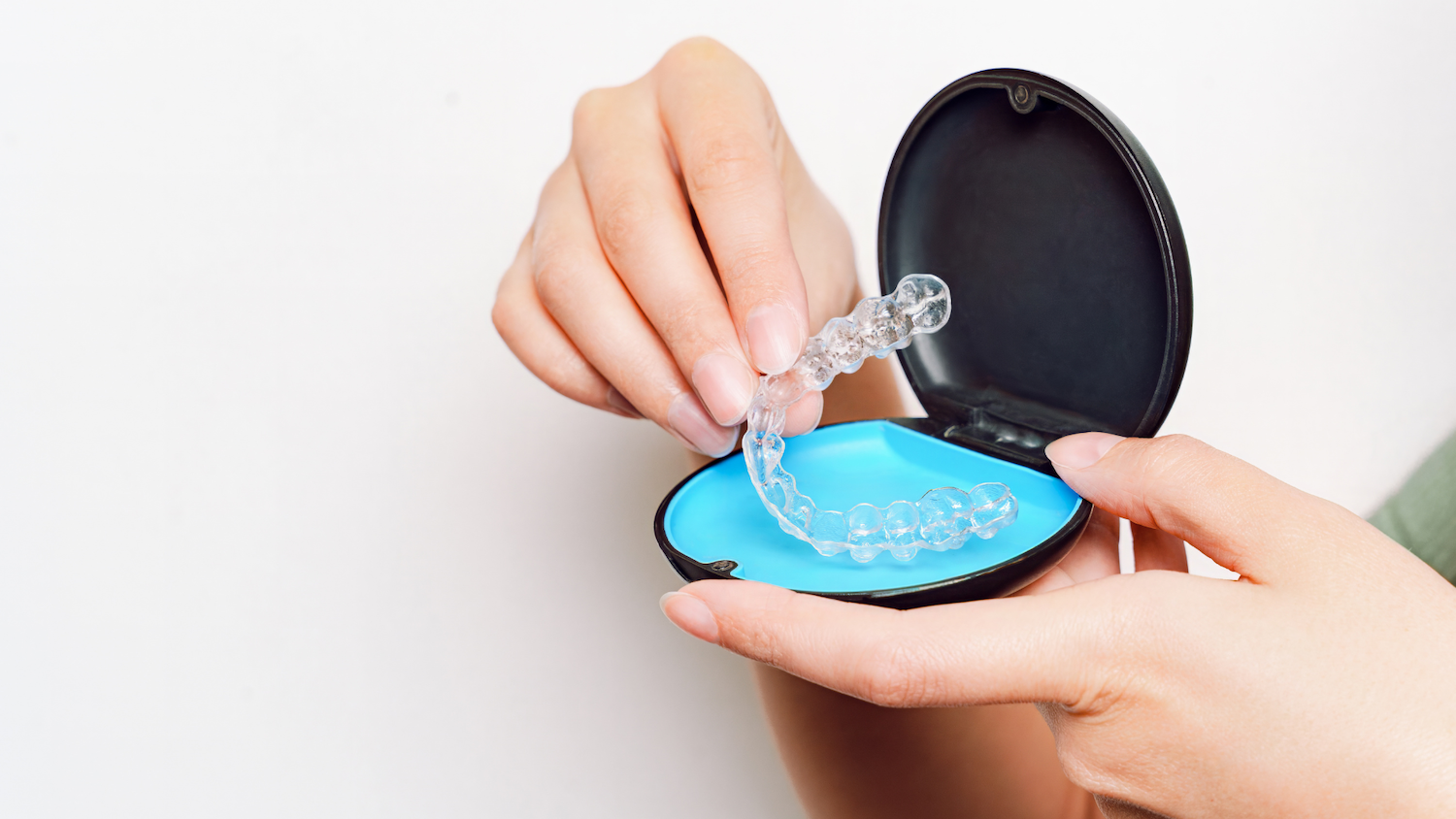
Invisalign is a teeth-straightening system that uses a series of clear, removable plastic aligners rather than fixed metal brackets and wires. Each aligner is custom-made to fit your teeth precisely, and over the course of your treatment, you work through a sequence of aligners that gradually shift your teeth into their new position.
The plastic is smooth, tight-fitting, and nearly invisible when worn. Most people standing in front of you would have no idea you were wearing them.
It was developed in the late 1990s and has since been used to treat millions of patients worldwide, ranging from mild crowding and spacing issues to more complex bite corrections. The technology behind it has improved significantly over the years, and today’s aligners are considerably more precise and effective than the earliest versions.
How does Invisalign actually move teeth?
This is the part most people are curious about. Teeth move when consistent, gentle pressure is applied to them over time. Traditional metal braces do this using wires and brackets. Invisalign does it using a sequence of custom-shaped aligners, each one designed to hold your teeth in a position that’s slightly ahead of where they currently are.
You wear each aligner for about one to two weeks before moving on to the next in the sequence. Each change is small on its own, a fraction of a millimetre in some cases, but the cumulative effect across your full treatment is what produces the result.
Small tooth-coloured attachments called “buttons” are sometimes bonded to certain teeth during treatment. These are tiny raised dots made from composite material (the same white filling material used in dentistry) that give the aligners something to push or rotate against. They blend in well, and they’re removed completely at the end of treatment.
Book your free cosmetic consultation
today
If you’re considering cosmetic treatments like Invisalign, veneers, whitening, implants, teeth straightening, or composite bonding, we’d love to welcome you to our clinic for a free consultation.
BOOK YOUR FREE CONSULTATIONThe whole process is mapped out digitally before a single aligner is made. Your dentist uses a 3D scan of your teeth and specialist software to plan every movement from start to finish, which means you can see a simulation of your predicted result before you even begin.
What happens at your first appointment?
At Love Teeth, all Invisalign consultations are dentist-led. That matters, because Invisalign is a clinical treatment, not a product you can properly evaluate without someone who understands tooth movement, bite function, and long-term dental health.
Your first consultation includes a full 3D digital scan of your teeth. There’s no messy impression material involved; a small wand passes over your teeth and produces a precise digital model in seconds. From that scan, your dentist creates a smile simulation showing you a projected outcome, which forms the basis of your custom treatment plan. A treatment coordinator then talks you through the costs and next steps.
The consultation costs £25 as a deposit, which is redeemable against your treatment if you go ahead.
How long does Invisalign treatment take?
It depends on what your teeth need. Some patients complete treatment in as little as six months; others with more complex movement may take 18 months or longer. The average for a comprehensive case sits somewhere around 12 to 18 months, but your dentist will give you a specific estimate based on your scan and treatment plan.
The speed of your treatment is also, to a meaningful extent, in your hands. Invisalign only works when you wear the aligners. The recommended minimum is 20 to 22 hours per day, which means they come out to eat, drink anything other than water, and to clean your teeth. That’s it. Patients who wear their aligners consistently tend to finish on time or ahead of schedule; those who don’t can find their treatment drifting.
What can Invisalign treat?
Invisalign is effective for a wide range of tooth alignment issues, including:
Crowding, where teeth overlap because there isn’t quite enough space
Spacing, where gaps exist between teeth
Overbite, where the upper front teeth sit too far forward over the lower ones
Underbite, where the lower teeth protrude in front of the upper teeth
Crossbite, where some upper teeth sit inside the lower teeth when biting down
Open bite, where the upper and lower front teeth don’t meet when the back teeth are closed
Not every case is suited to aligners alone. More complex bite corrections, particularly those involving significant jaw movement, may need a combined approach. Your dentist will be honest with you about whether Invisalign is the right fit for what you’re trying to achieve.
Is Invisalign as effective as traditional braces?
For the cases it’s designed to treat, yes. The clinical evidence supporting Invisalign has grown considerably over the past decade, and in the hands of an experienced provider, outcomes are comparable to fixed braces for most tooth alignment issues.
Book your free cosmetic consultation
today
If you’re considering cosmetic treatments like Invisalign, veneers, whitening, implants, teeth straightening, or composite bonding, we’d love to welcome you to our clinic for a free consultation.
BOOK YOUR FREE CONSULTATIONThe provider matters enormously here. Invisalign assigns providers a tier based on the number of cases they treat each year. Love Teeth holds Diamond Apex status, placing the practice among the top 1% of Invisalign providers across Europe. Dr Kunal Patel, the principal dentist, is an Invisalign global ambassador and lecturer, which means he trains other dentists in the system. That level of experience with the treatment makes a genuine difference to the complexity of cases that can be handled and the precision of the results.
What’s included at Love Teeth?
Love Teeth offers the Invisalign ABC package, which bundles the core treatment with teeth whitening, retainers, and finishing touches including contouring and bonding where needed. It’s designed so that the end result is a complete outcome, not just straight teeth.
Finance is available with 0% over 12 months, and longer-term options at 16.9% over 24 to 60 months, with no deposit required on treatment costs above £1,000.
What happens when treatment ends?
Retainers. This is the part people sometimes overlook. Once your aligners have moved your teeth into position, retainers are what keep them there. Teeth have a natural tendency to drift back towards their original position, particularly in the months immediately after treatment.
Love Teeth includes retainers as part of the Invisalign ABC package. Wearing them as directed, typically every night long-term, is what protects the result you’ve worked for.
Ready to see what’s possible?
The best way to know whether Invisalign is right for you is to have your teeth scanned and your options mapped out properly. At Love Teeth, that means a dentist-led consultation with a 3D scan and smile simulation included, so you can see a projected result before you commit to anything.
Book your Invisalign consultation at any of our six Surrey locations, or call 020 8337 0629 to find out more.
Frequently asked questions
Does Invisalign hurt?
It’s common to feel some pressure or mild discomfort for a day or two when you move to a new aligner. This is a sign the aligners are working. Most patients describe it as more noticeable than painful, and it tends to settle quickly. It’s quite different from the soreness that can follow a tightening appointment with traditional braces.
Can I eat and drink normally with Invisalign?
Yes, because you remove your aligners to eat and drink. You can eat whatever you like during treatment. The key discipline is making sure the aligners go back in immediately after, and that you clean your teeth before doing so.
Will Invisalign affect my speech?
Some people notice a slight lisp in the first few days as their tongue adjusts to the aligners. It almost always resolves within a week or so as you adapt. Most patients find there’s little noticeable impact on speech once they’re past the initial adjustment.
How often do I need to come in for appointments?
Typically every six to eight weeks, though this varies by practice and treatment stage. These check-up appointments are shorter than traditional brace adjustments, usually around 20 to 30 minutes.
Am I too old for Invisalign?
No. Invisalign treats adults of all ages. The aligner system is particularly popular with adults who want to improve their smile without the visibility of traditional braces.
Book your free cosmetic consultation
today
If you’re considering cosmetic treatments like Invisalign, veneers, whitening, implants, teeth straightening, or composite bonding, we’d love to welcome you to our clinic for a free consultation.
BOOK YOUR FREE CONSULTATION